We use cookies to keep this site working, measure how visitors use it, and improve the experience. You can choose which categories to allow. Read our cookie policy.
Free downloads
Playbooks for fabricators who want to win 2026
Practical PDFs you can actually use Monday morning. Yours in exchange for an email.
A practical blueprint for moving from manual quoting and disconnected shop-floor data to a connected RA Workshop workflow with validation, production reports, and CNC-ready output.
Understand the window basics in plain language.
Know which quoting mistakes RA Workshop prevents for you.
Follow a calm first-quote workflow from request to PDF.
Your PDF arrives in under a minute
Example resource
New in the office? Start quoting windows without fear.
A friendly first-day guide for the new office colleague who suddenly has to prepare window and door offers, even without an engineering background.
Understand the window basics in plain language.
Know which quoting mistakes RA Workshop prevents for you.
Follow a calm first-quote workflow from request to PDF.
First-day confidence
You do not need to be an engineer to make a safe first quote.
Imagine this: you are new in the office, the owner knows every machine and every profile by heart, and now you are asked to help modernize how the company prepares offers. The products are technical, the customers expect fast answers, and one wrong number can become an expensive factory problem.
That can feel frightening, but the pressure is not proof that you are unprepared. The old way of quoting forced beginners to memorize catalogues, copy prices between spreadsheets, and guess whether a design was physically possible. RA Workshop changes the job. It gives you a guided workspace where the technical rules, costs, weights, and compatible parts are checked in the background.
Your role becomes much more human: listen to the customer, choose the right style, confirm the dimensions, and present a clear professional offer. The software handles the hidden engineering checks that would normally take years to learn.
Window basics
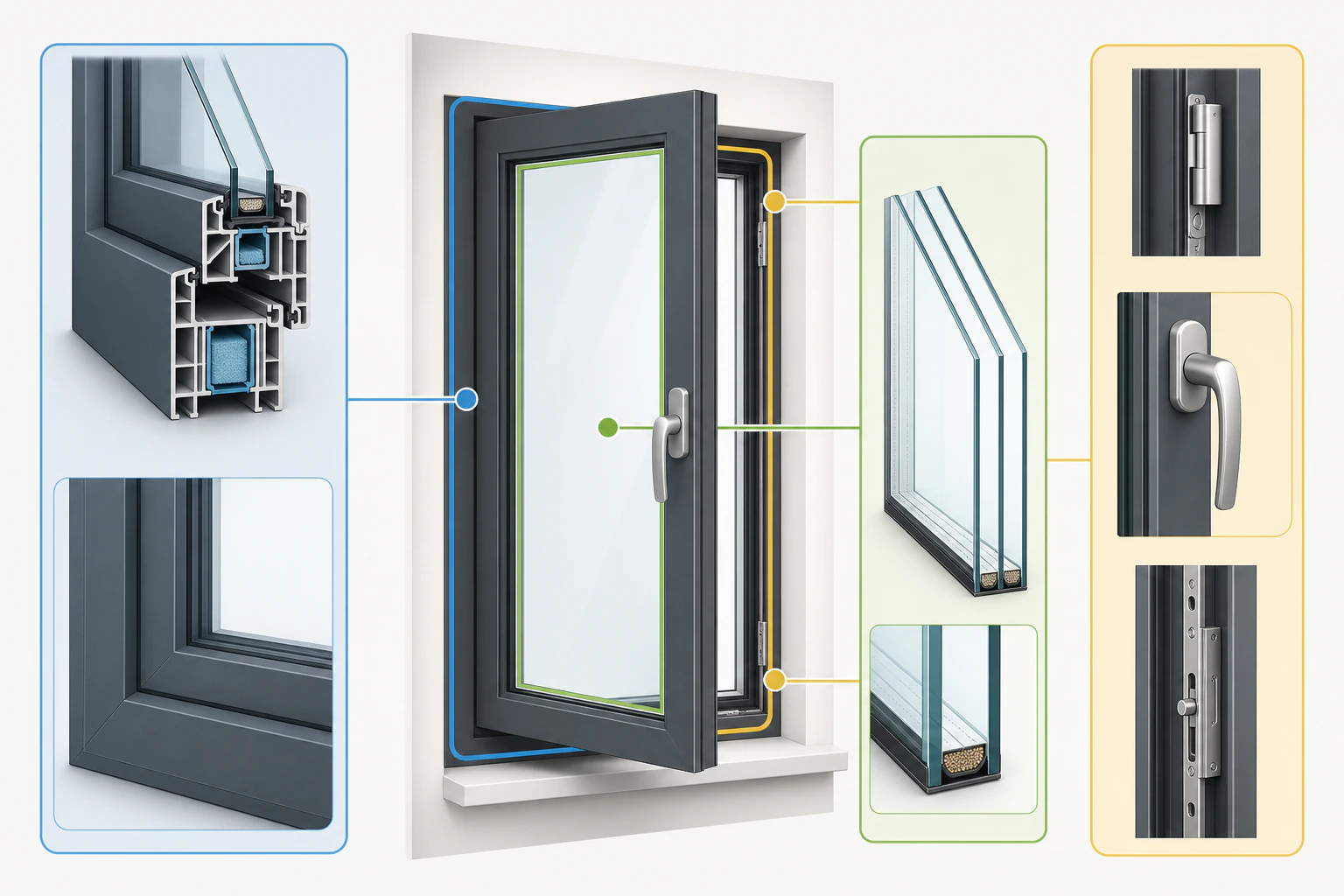
Think of every window as three friendly parts: frame, glass, and movement.
The word fenestration simply means the openings in a building: windows, doors, skylights, façades, and similar products. The term sounds complicated, but the everyday product is easier to understand when you break it into three parts.
The profile or frame is the skeleton. It gives the window shape, strength, insulation chambers, and a clean connection to the wall. It may be uPVC, aluminium, wood, or a hybrid system. The glazing is the shield. It can be single, double, or triple glass, often with Argon gas, Low-E coatings, tempered safety glass, laminated security glass, or privacy finishes. The hardware is the muscle. Handles, hinges, locks, balances, and tilt-and-turn mechanisms make the heavy window move smoothly and seal tightly.
Once these three ideas are clear, the intimidating catalogue becomes a set of choices. RA Workshop stores those choices as structured data, so the software knows which profiles, glass units, and hardware can safely work together.
Profile: the structural frame and sash that hold the product together.
Glazing: the insulating glass unit that controls heat, sound, light, privacy, and safety.
Hardware: the moving and locking parts that make the window usable and secure.
Configuration: the complete combination of size, profile, glass, hardware, colour, extras, and price.
Why the old way hurts
Manual quoting makes beginners carry risks that software should carry.
A custom house quotation can contain dozens of different windows. In a manual workflow, someone has to calculate profile lengths, glass areas, hinge capacity, rubber seals, labour, waste, discounts, and margin by hand. A tired beginner working inside a fragile spreadsheet can miss one reinforcement, one profile price, or one glass weight and destroy the profit on the job.
The more dangerous problem is the invalid configuration. A customer may ask for a very wide, heavy, triple-glazed opening. If it is quoted with standard lightweight hardware, the product may be impossible to manufacture safely. Without automatic checks, the mistake is often discovered late: on the factory floor, after materials are cut, when everyone is already under pressure.
Manual offers are also slow and hard to trust. Customers compare suppliers quickly. If your quote arrives days later as a dense spreadsheet with no clear visuals, a faster competitor can win even with a higher price.
Your software safety net
RA Workshop behaves like an invisible senior engineer beside you.
RA Workshop is built specifically for windows and doors. Instead of starting from a blank sheet, you work with ready window templates, profile systems, glass options, hardware rules, pricing tables, extra costs, discounts, and branded proposal reports.
The most reassuring part is the valid-configuration engine. When the database knows the limits of a profile, the weight of the glazing, and the capacity of the hardware, it can stop unsafe combinations before they become a quote. If a glass change makes the sash too heavy, the software recalculates the weight and guides the selection toward stronger compatible hardware.
At the same time, RA Workshop calculates the bill of materials, profile lengths, cutting optimisation, glass sizes, gaskets, screws, labour, extras, margins, and discounts. The final output is not just a number. It is a professional quote, order confirmation, dealer quote, or production-ready document that looks serious to the customer and useful to the factory.
Fast templates help you start from real window and door types instead of a blank page.
Validation rules prevent combinations the factory should not build.
Automatic BOM and cutting data protect material costs and margins.
PDF, Word, and Excel reports turn technical work into a polished client proposal.
Your first quotation
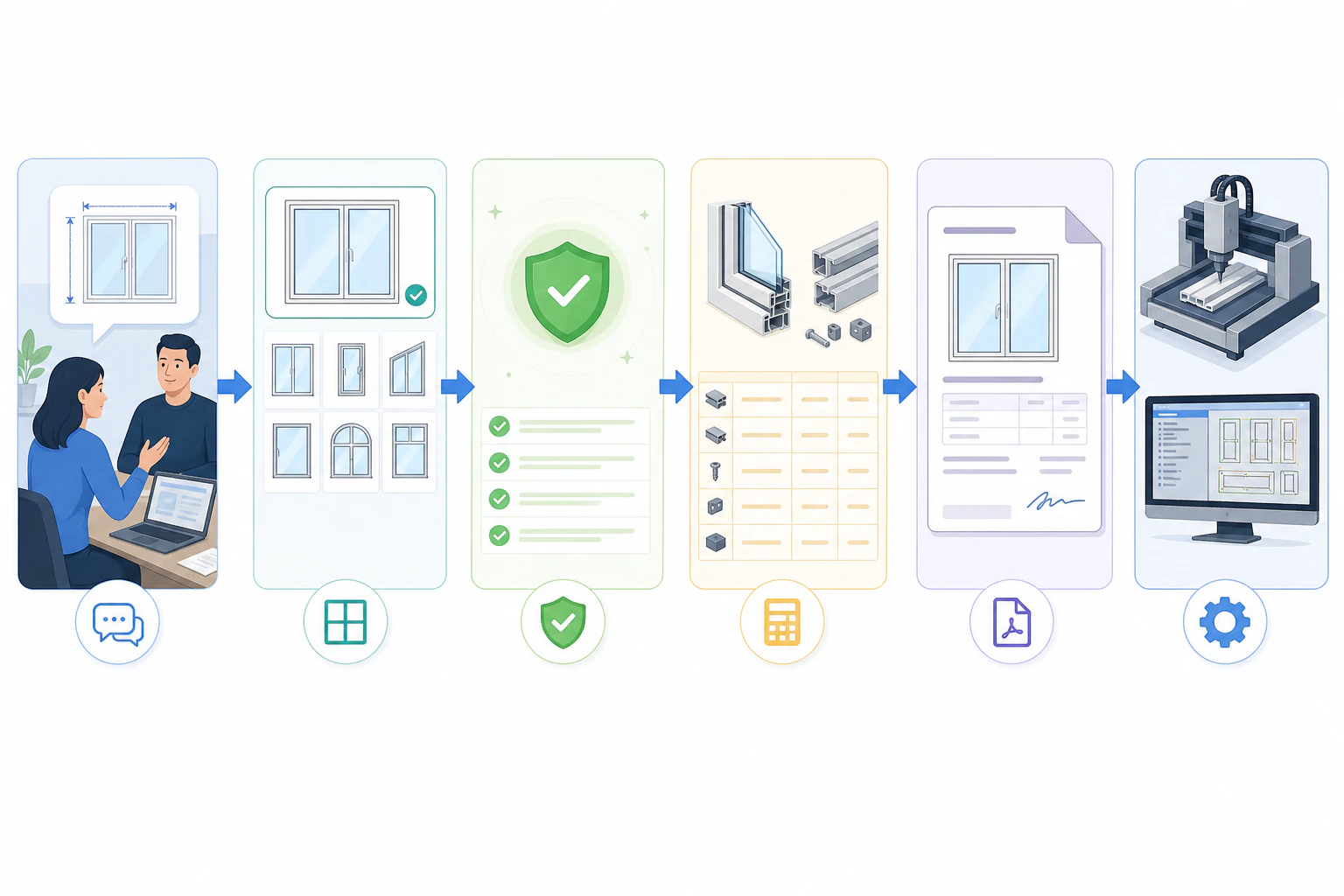
A calm six-step workflow for your first real customer request
Use this as a mental checklist when the phone rings or the owner forwards you a measurement sheet.
1
Create the project
Add the client, site address, contact details, and short notes while the request is fresh.
2
Choose a template
Start from a Window Library design such as fixed, tilt-and-turn, sliding, French door, or another common structure.
3
Enter dimensions
Type the measured opening sizes and let the visual model redraw the product to scale.
RA Workshop checks weights, compatibility, BOM, waste, costs, and margin while you keep the customer experience clear.
6
Send the quote
Export a professional PDF or table quote with the right visuals, descriptions, and pricing for the audience.
Quick glossary
Small words that make the first week easier
Keep these nearby. They turn a technical conversation into something you can follow.
Profile
The frame system, often uPVC, aluminium, wood, or hybrid, that gives the window structure.
Sash
The moving or fixed inner part that directly holds the glass.
IGU
Insulated Glass Unit: two or three glass panes sealed together with air or gas between them.
Low-E
A thin coating on glass that helps reflect heat and improve energy performance.
Hardware
Handles, hinges, locks, balances, and mechanisms that make the window move and seal.
BOM
Bill of Materials: the list of profiles, glass, fittings, screws, gaskets, and other parts needed for production.
The best first week is guided, visual, and impossible to quote dangerously.
RA Workshop helps a new office employee move from fear to useful work quickly: professional proposals for customers, accurate data for production, and fewer stressful surprises for everyone.