


Why production optimization is no longer optional in fenestration
The global market for uPVC and aluminium windows and doors in 2026 is reshaping itself under three simultaneous pressures: violent raw-material volatility, a permanent shrinkage of the skilled-labour pool, and aggressive new environmental rules. Aluminium import surcharges introduced in the United States, EU export restrictions targeting scrap leakage, and the carbon costs imposed by mechanisms such as CBAM have all combined to convert profile inventory from a routine consumable into a strategic, closely-guarded asset.
uPVC has not escaped. Because resin pricing remains tightly tethered to the petroleum complex, every spike in crude futures rolls forward into your profile cost within a quarter. Manufacturers who cannot control their material yield are now exposed to margin swings that would have been considered catastrophic only five years ago.
The labour story is just as decisive. Bench joiners, machine operators, welders and qualified estimators are scarce in every European market and being actively recruited toward Western Europe at premium wages. Relying on the tribal knowledge of a single veteran operator to plan cut lists, intuit yield, and configure complex machining centres is no longer a defensible business model. To survive and scale, fenestration manufacturing has to pivot to algorithmic optimization, predictable maintenance and integrated automation.
This article is a two-part operational blueprint. Part one is the Zero-Waste Workshop: the engineering and software discipline that drives material scrap from a typical 18–25% baseline down toward a 4–5% irreducible minimum. Part two is the 90-Day Roadmap: a phased, low-risk path from manual production into fully CNC-integrated, paperless manufacturing — with RA Workshop acting as the digital nervous system that pushes precise instructions to every saw, welder and machining centre on the floor.

Material waste is not overhead — it is pure lost profit
In discrete fenestration manufacturing, raw materials routinely make up 70–80% of total operating cost. Yet many plants still treat a 10–15% waste rate as the unavoidable cost of doing business. That single assumption is the largest hidden drain on profitability in the industry.
When a facility runs at an 18–25% true waste rate — extremely common in shops that plan cuts manually or work in a 'cut-as-you-go' rhythm — the financial bleeding is much wider than the price of a six-metre extrusion thrown into the recycling bin. It includes every minute of operator time spent unloading, handling, machining and cleaning material that will never become a billable window. It includes the opportunity cost of throughput that could have been used to ship a paying job. It includes the rising commercial cost of waste removal and the regulatory friction of segregating, transporting and reporting scrap.
Disorganised offcut piles also create their own gravity well. They block forklift lanes, hide near machines, soak up moisture, get scratched, and ultimately get downgraded from 'usable remnant' to 'landfill' simply because nobody could find them when they were needed. The factory pays for the same length of profile twice — once when it is bought, and again when its potential remnant value is destroyed by the storage environment.
The mindset shift required of every modern production manager is simple: scrap reduction is not a secondary housekeeping goal, it is a primary revenue strategy. By layering an algorithmic optimizer on top of a disciplined inventory of remnants, manufacturers routinely move material yield from a manual baseline of 75–85% up to an optimized 90–95%. That gap is a direct 10–15% recovery of margin, every single month, on the same revenue.

The mathematics behind a 95% material yield
Manual cut planning is mathematically broken. Even the best operators rely on shortcuts that do not account for the combinatorial complexity of nesting hundreds of part lengths into a mixed-length stock pool. Faced with that mental load, humans default to cutting fresh six-metre extrusions instead of solving the geometry that would consume an existing remnant first.
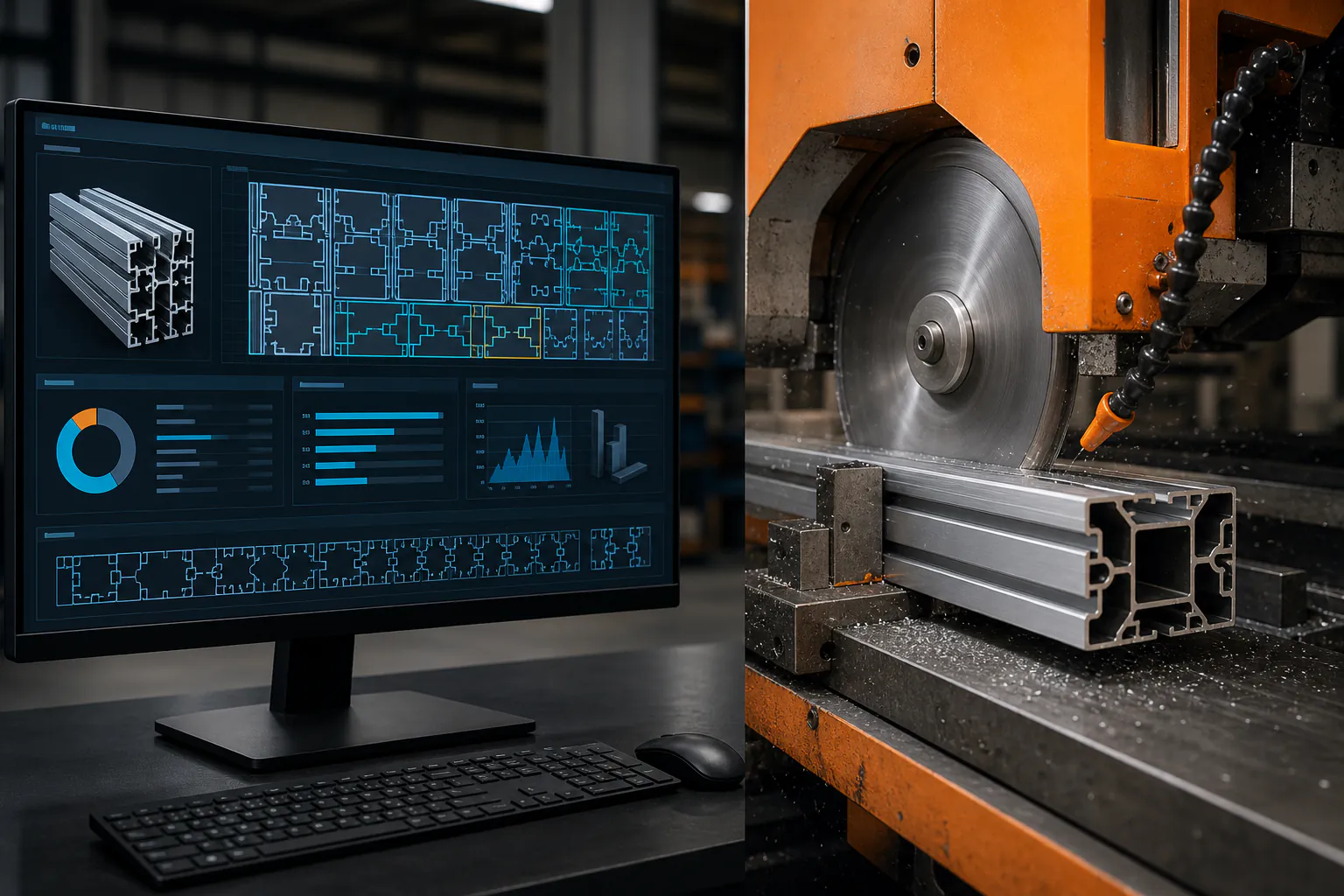
Modern cutting optimisers solve this with combinatorial algorithms and mixed-integer linear programming. The software evaluates the live Bill of Materials against current inventory, generates millions of potential layouts in milliseconds, and selects the arrangement that maximises yield across the entire batch. To do that reliably, the algorithm has to account for several technical realities that human planners cannot hold in their head at the same time.
Kerf compensation: the physical thickness of the saw blade is subtracted from every cut so a 4 mm kerf does not silently steal 40 mm across ten cuts.
Multi-stock and dynamic length support: the optimiser picks the right starting length from the available pool of full bars and remnants instead of always defaulting to a fresh six-metre stick.
Defect handling and directional constraints: foiled uPVC, anodised aluminium and timber respect grain or pattern direction; flagged defective sections are nested around automatically.
Common-line cutting and 2D nesting: shared edges in panel cutting are processed with a single pass to save material, gas and tool wear.
Wastage thresholds: the manager defines what is still 'usable remnant' versus what should be classified as scrap, so the software stops generating tiny unusable rests.
Why fenestration-specific algorithms beat general cut-list tools
Generic cut-list calculators are not designed for the geometric complexity of modern fenestration. Casements, tilt-and-turn systems, sliding monorails, French and lift-and-slide doors, multi-chambered thermal-break profiles — each behaves differently and brings its own hardware, glazing and reinforcement constraints. Without industry-specific intelligence, the optimiser cannot tell whether its 'optimal' layout produced a window that the factory can physically build.
RA Workshop is built specifically for uPVC, aluminium, wood and steel fenestration. Across its Lite, Express and Professional editions, an approved client quotation is converted directly into an optimized cutting plan and a complete production package. The Professional edition's combinatorial engine treats an entire customer order — or a batched group of orders — as one global optimisation problem rather than a series of per-window calculations. Pooling the cuts dramatically expands the space the algorithm can search, which is what makes the documented 12–20% material savings possible.
The same centralised pricing brain protects the savings on the commercial side. Because every profile, hardware item and accessory has one canonical price, a supplier surcharge is updated once and propagates instantly across every open quote, dealer showroom and live order. The yield gains earned on the saw cannot be silently eroded by an out-of-date estimation spreadsheet.
| Edition | Target audience and scale | Core capabilities | CNC integration |
|---|---|---|---|
| RA Workshop Lite | Solo installers and new showrooms (free tier). | Basic estimation for uPVC, aluminium and wood; rectangular frames; PDF and Excel export. | None — designed for manual execution. |
| RA Workshop Express | Small teams (1–10 people) and dealer networks. | Free-form shapes, all opening types, accurate profile pricing and automated glass orders. | Prepares structural data; no direct machine linkage. |
| RA Workshop Professional | Active workshops and factories (5–50 people). | Full production system: 12–20% cutting optimisation, remnant management, complete technical analysis. | Direct export to saws, welders and machining centres. |
Turning offcuts from waste into a tracked second-tier stock
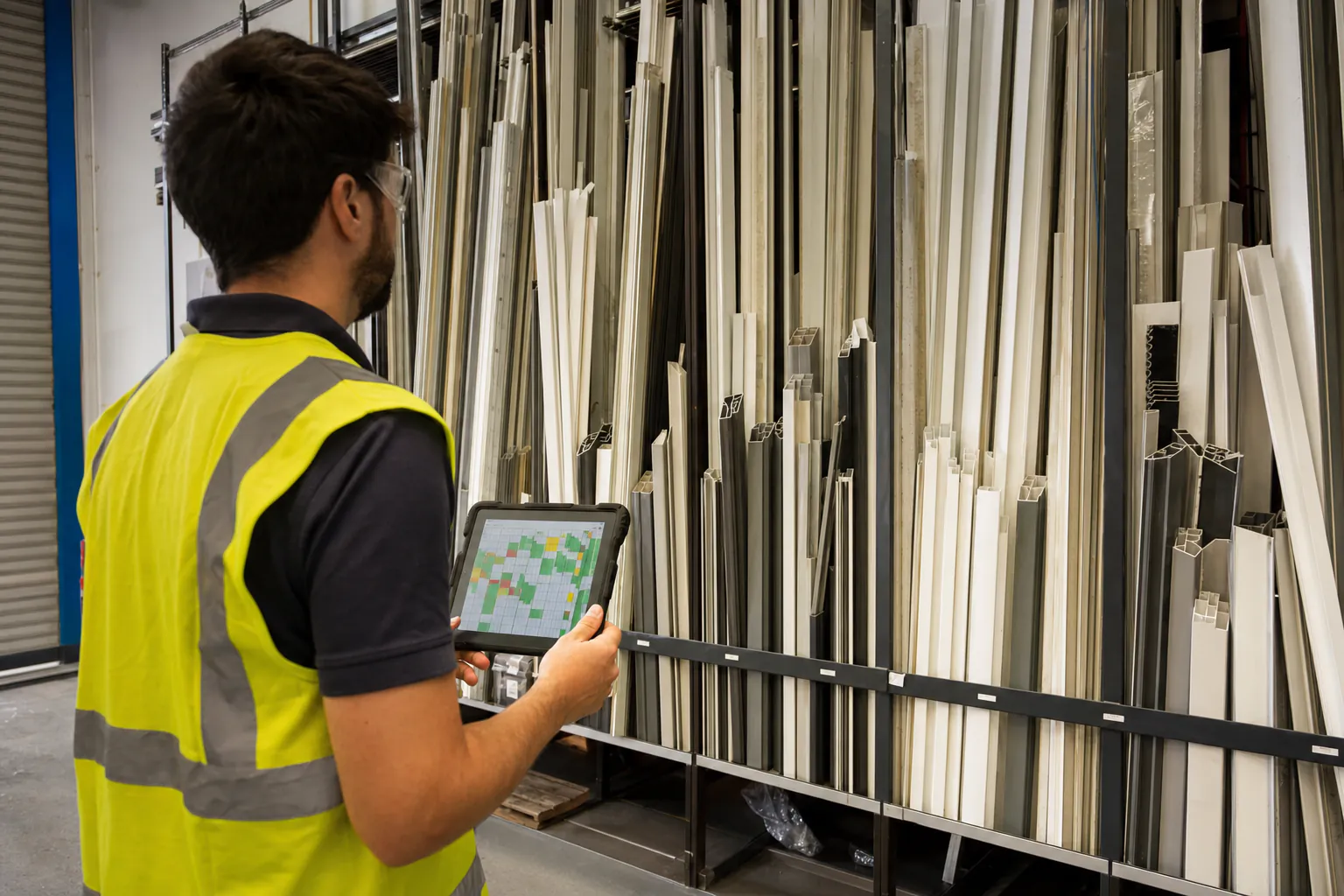
An optimised cut plan only solves half the equation. The other half is what happens to the remnants the optimiser inevitably produces. Without a tracking discipline, valuable offcuts are either tossed in the recycling bin too early, or accumulate in unmarked stacks on the shop floor where exposure, handling damage and pure inability to find them eventually downgrades them to scrap.
The 2026 standard for industrial fenestration is dynamic, closed-loop inventory tracking. Inside the RA Workshop ecosystem, the RA Inventory module on a client–server architecture keeps that data centralised across the entire organisation. When a new production order is generated, the software does not blindly subtract full lengths from the digital ledger. It first queries the database for a tracked remnant that satisfies the dimensional requirement — and instructs the operator to pull that specific bar from a specific bin before opening a fresh extrusion.
For that to work, the physical and digital sides have to agree. Every usable remnant is logged with its dimensions, profile reference, colour or foiling, and a precise storage location. Storage itself respects the realities of the materials: dry, well-ventilated, profiles laid horizontally, supports no further than one metre apart so they do not bow under their own weight, and never stacked beyond a safe height. Aluminium is wrapped against moisture and alkalis to prevent oxidation; uPVC packaging is opened at the ends so condensation can escape rather than rot the chambers from the inside.
When physical storage discipline meets a live remnant database, procurement can stop ordering material that is already sitting in a rack. That is one of the cleanest cash-flow improvements a fabrication business can make.
5S, value-stream mapping and a credible circular-economy story
Even with industry-leading optimisation and meticulous offcut tracking, fenestration production will always generate some irreducible scrap: swarf from milling and drilling, micro-trimmings, rejected parts, defective extrusions. Containing that residual stream requires Lean discipline and an honest circular-economy plan.
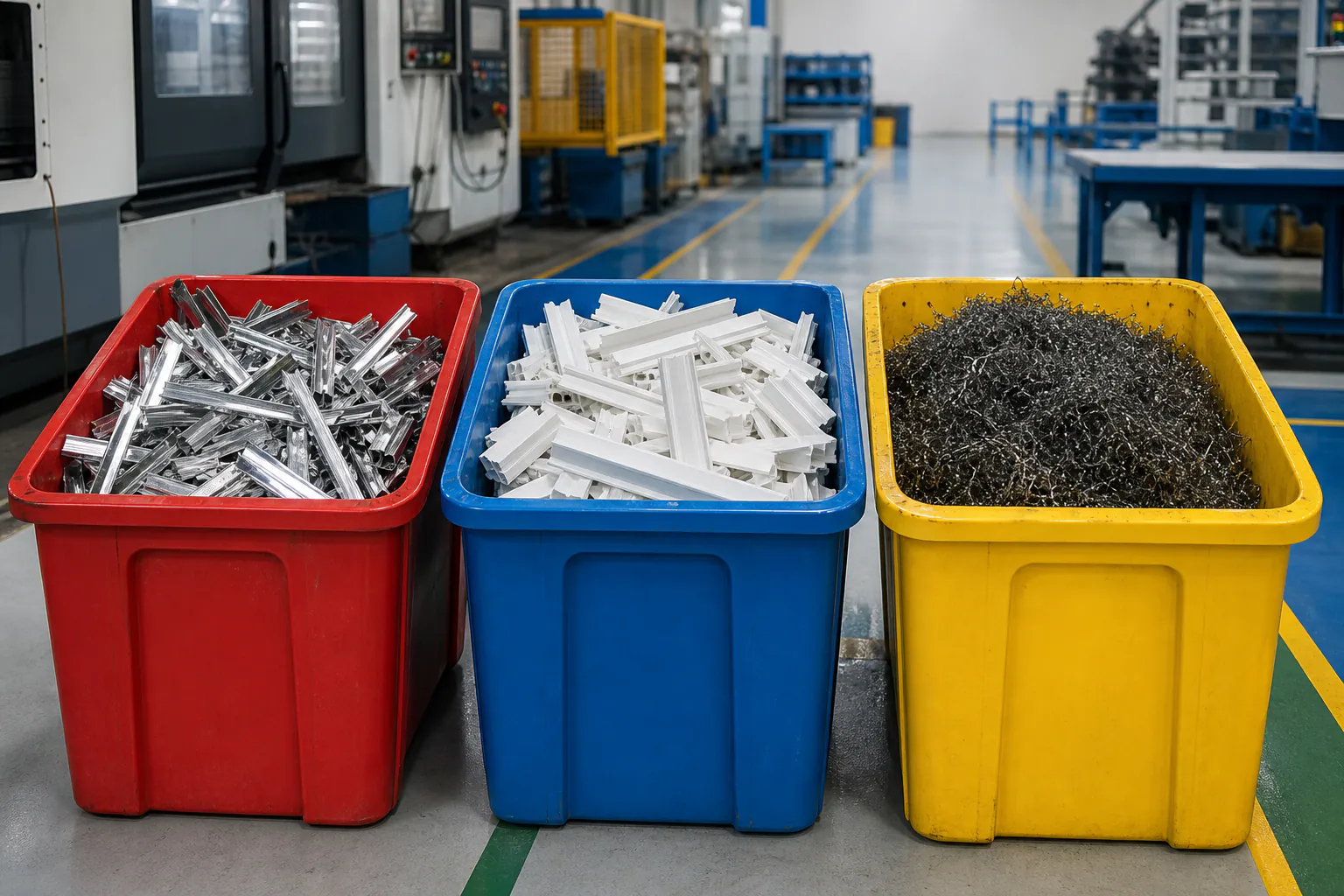
Lean tools — particularly the 5S framework (Sort, Set in Order, Shine, Standardise, Sustain) and Value Stream Mapping — are how you remove non-value-adding handling. Scrap collection bins live directly at the cutting and machining stations, so segregation happens at the moment of generation rather than as a retrospective sort. Cross-contamination is the enemy: aluminium swarf mixed with uPVC offcuts, or steel reinforcement shavings blended with polymer waste, destroys the recycling value of every component in the bin. A colour-coded, station-level system keeps the streams pure and saleable.
Both materials reward the discipline. Recycling aluminium needs roughly 95% less energy than smelting primary bauxite, which makes a clean stream a genuinely lucrative commodity. Modern uPVC recycling shreds, cleans and re-melts post-industrial scrap into the structural core of new closed-loop profiles, which are co-extruded with a virgin-grade exterior skin so colour, gloss and UV stability are preserved. That core saves on the order of 2,000 kg of CO₂ and 1,800 kWh of energy per batch versus virgin resin.
Treating the factory as a node in a circular supply chain — rather than as a one-way consumer of new material — pushes net waste toward zero, recovers cash, and produces the documentation you need for green-building certifications such as LEED.

The CNC operator checklist that keeps software savings real
The most sophisticated cutting algorithm and the most disciplined remnant database collapse the moment the physical machine drifts out of tolerance. Thermal expansion, worn spindle bearings, accumulated ball-screw backlash and quietly leaking hydraulic pressure will produce defective parts faster than software can save material. Fenestration CNC equipment routinely needs positional accuracy down to thousandths of a millimetre to assemble complex mitres and thermal-break alignments correctly.
Reaching that level of reliability requires a culture shift from reactive repair to predictive preventive maintenance. The checklist below should be embedded in the daily, weekly and monthly routines of every operator — ideally signed off through a digital CMMS so adherence is visible to management.
| Cadence | Subsystem | Action | Yield impact |
|---|---|---|---|
| Daily, pre-shift | Work area and enclosure | Purge swarf and dust from the bed, T-slots, fixtures and way covers; clean viewports. | Prevents trapped chips from interfering with pneumatic clamping and causing material slippage. |
| Daily, pre-shift | Spindle and tooling | Run the manufacturer warm-up routine; inspect tool holders for wear; verify offsets; clean tapers and apply chuck grease. | Eliminates thermal expansion in the first cuts and protects kerf width and surface finish. |
| Daily, pre-shift | Fluids and hydraulics | Check hydraulic pressure, auto-lube levels and coolant concentration; empty the chip pan; test E-stops and interlocks. | Removes the leading cause of mechanical drift and prevents material burning or edge distortion. |
| Weekly, ~40 hours | Motion components | Inspect linear rails, guideways and ball screws for debris; check belt tension and drive coupling alignment. | Eliminates backlash and stick-slip so cut lengths match the program at micron level. |
| Weekly, ~40 hours | Filtration | Clean controller cabinet air filters, coolant tank filters and dust extraction hoses; inspect pneumatic water traps. | Prevents controller overheating and protects internal pneumatics from PVC and aluminium dust. |
| Monthly, ~160 hours | Calibration and alignment | Verify squareness and tram, run a backlash program, confirm homing and limit switches, check tool release cylinders. | Secures geometric precision across long frames, protects 45° and 90° welds, drastically cuts rework. |

From manual to automated without breaking the shop
Despite the obvious upside of automated fenestration manufacturing, the move from manual workflow to a fully integrated CNC line is operationally risky. Industry data is consistent: digital transformation projects rarely fail because of the machinery itself. They fail because of poor change management, disconnected data silos and the absence of a standardised workflow.
When a factory installs a high-end Elumatec machining centre, a Graf Synergy seamless welding line or a Kaban cutting cell without first structuring its data and digital pathways, the result is local chaos. Operators end up reading printed spreadsheets and re-keying coordinates directly into machine controllers, which reintroduces the very human error the equipment was bought to eliminate.
The antidote is a phased, uncompromising rollout. The 90-day roadmap below moves a facility from isolated manual cells to a unified, software-driven ecosystem, with RA Workshop acting as the digital nervous system that pushes post-processed machine code directly to the floor. The objective is the state every modern shop wants to live in: zero re-typing, zero errors and zero rework.

Phase 1 — foundation, data preparation and floor mapping
The first month of the roadmap involves zero contact with the new machinery. It is dedicated to digital readiness, standardising procedures, and reshaping the physical flow of the facility for high-speed automation.
Week 1 is for process assessment and Value Stream Mapping. Engineering tracks the journey of a window from raw extrusion to shipped product, names every existing bottleneck, and exposes the data gaps that will need to close. Cross-functional teams (operators, IT, production managers) agree on a measurable goal — for example a 20% cycle-time cut, or eliminating manual cut-list generation — and set the baseline that ROI will eventually be calculated against.
Week 2 is layout. Functional layouts where saws live in one corner and welders in another generate 'spaghetti' WIP travel; CNC integration demands a line or cellular layout where work and transport lanes never cross. A 3D digital twin or a layout simulator (Tecnomatix, Moicon or equivalent) is used to plan spatial clearances, material buffers and seamless in-feed and out-feed for the new cutting centres. A cardinal rule: any flat horizontal surface that is not explicitly assigned a purpose will end up storing defective parts. Eliminate them.
Weeks 3 and 4 are database configuration. Inside RA Workshop, the implementation team uploads the technical specifications of every profile system, hardware matrix, glass package, accessory and price formula the factory will use. This is where the discipline pays off: each digital model carries every attribute the machinery will eventually need — drainage hole locations, hardware routing depths, reinforcement rules, weld preparation. Get the 'data contracts' right here and Phase 2 stops being an integration project and starts being a configuration exercise.

Phase 2 — linking machinery and automating data flow
With the layout right and the database structurally sound, the second month builds the digital bridges between RA Workshop and the specific equipment on the floor.
Week 5 configures the CNC modules and the integrated CAD/CAM environments. Drainage holes, air-balance channels, V-cuts, mullion routing and hardware installation slots stop being decisions an operator makes from a paper drawing — they are programmed coordinates inside the software. The system is taught the rules of each profile system so, for example, a drainage hole can never compromise an internal steel reinforcement.
Week 6 is post-processor alignment and machine linkage. Different machinery brands speak slightly different dialects of G-code over different protocols. The RA Workshop CNC add-on translates the geometry produced in CAD into the exact format each target machine expects — whether that is an Elumatec, Graf Synergy or Kaban cutting centre, a Sturtz or Soenen Hendrix welding line, or a Mecal, Soukup or Thorwesten machining centre. Direct TCP/IP or serial connections are established so the controller can pull files directly from the server. USB sticks and emailed drawings are formally retired.
Weeks 7 and 8 are pilot testing. CAM programs are first executed as dry runs on the machines to validate tool paths and detect collisions between spindle and clamps. Then a small batch of physical test profiles is processed and inspected against the original 3D models with calipers, profile projectors and gauges. Any deviation — a milling depth slightly off, a mitre angle out of square, a rough surface finish — is corrected by refining the software offsets, the feed and speed parameters or the machine calibration. By the end of week 8, the line should be running real parts to design intent without manual touch-up.
Phase 3 — eliminating manual error and scaling the model
The final month converts the validated pilot into full-scale, factory-wide adoption. The objective is to sever the shop's dependence on paper routing and to embed Industry 4.0 connectivity into the everyday culture of the workforce.
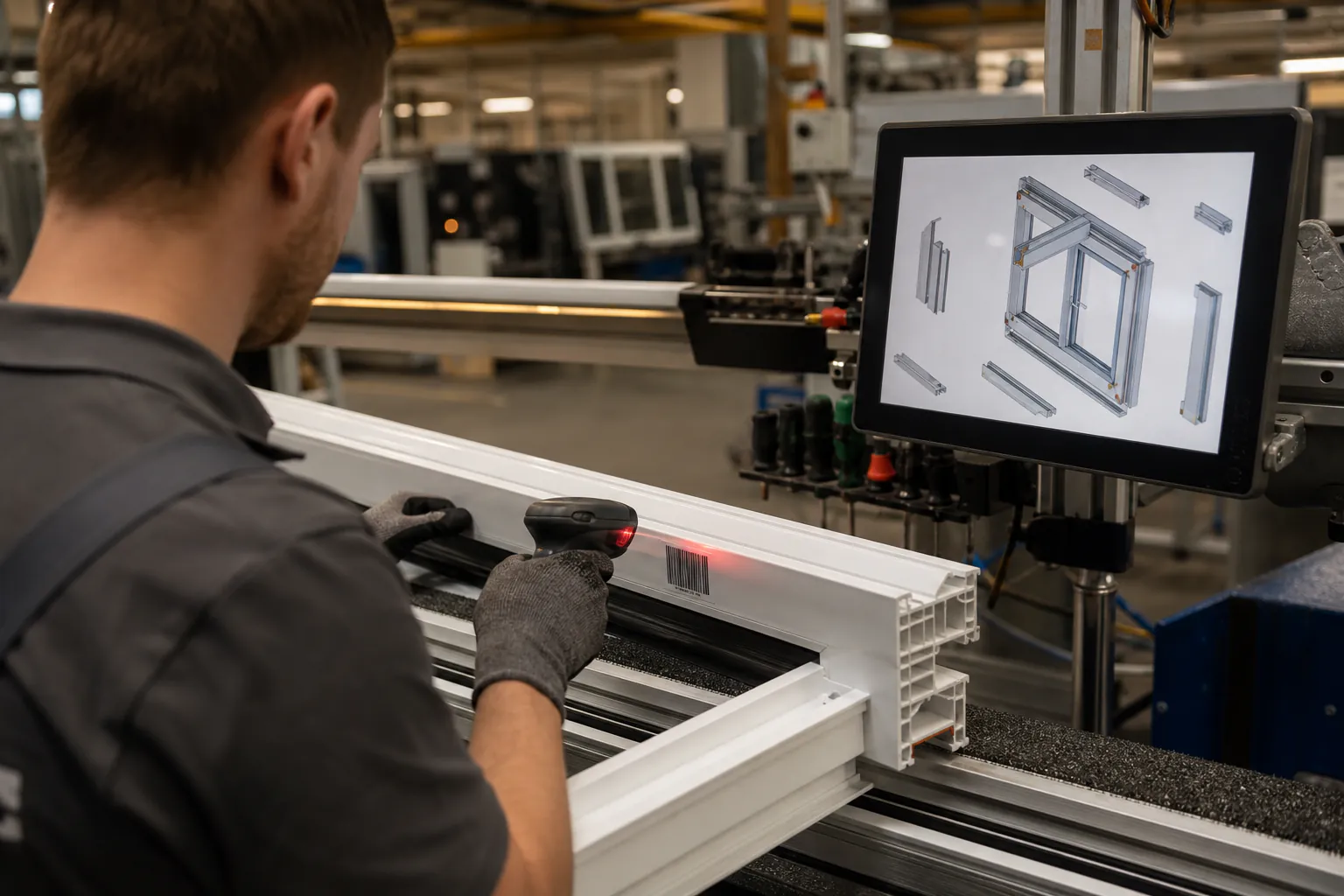
Week 9 is paperless production and barcoding. RA Workshop generates synchronised barcode labels for profiles, glass units and assembled modules in a single click. As cut profiles leave the saw, operators apply the labels. At every downstream station — welding, corner cleaning, hardware assembly — the operator does not consult a paper ticket; they scan the code. The barcode pulls the live instructions, 3D assembly diagram and digital work order onto the local terminal. Misread handwriting, lost paperwork and outdated drawing revisions stop being possible.
Week 10 is Smart Office Tools and office-system integration. Production data flows back into CRM, finance and logistics. Live tracking lets dispatch plan vehicles dynamically and quote precise completion times to clients. Inventory is decremented automatically as cuts are made, which generates clean reorder signals for procurement and ends both stockouts and the bloat of carrying 'just in case' material. Where tooling such as Retrieval-Augmented Generation knowledge bases is deployed on top, staff can query SOPs and technical manuals in natural language, which collapses onboarding time for new hires.
Weeks 11 and 12 are training, cultural adoption and continuous improvement. Operators move from physical cutting and measuring toward digital oversight, quality assurance and preventive maintenance. They learn to read alarms, manage tool life and interpret software feedback. From this point the production manager's job changes shape: real-time dashboards fed by the CNC machines and the RA Workshop server expose throughput, OEE and scrap rates continuously, and the optimisation parameters can be tuned against historical performance to push yield closer to absolute perfection.
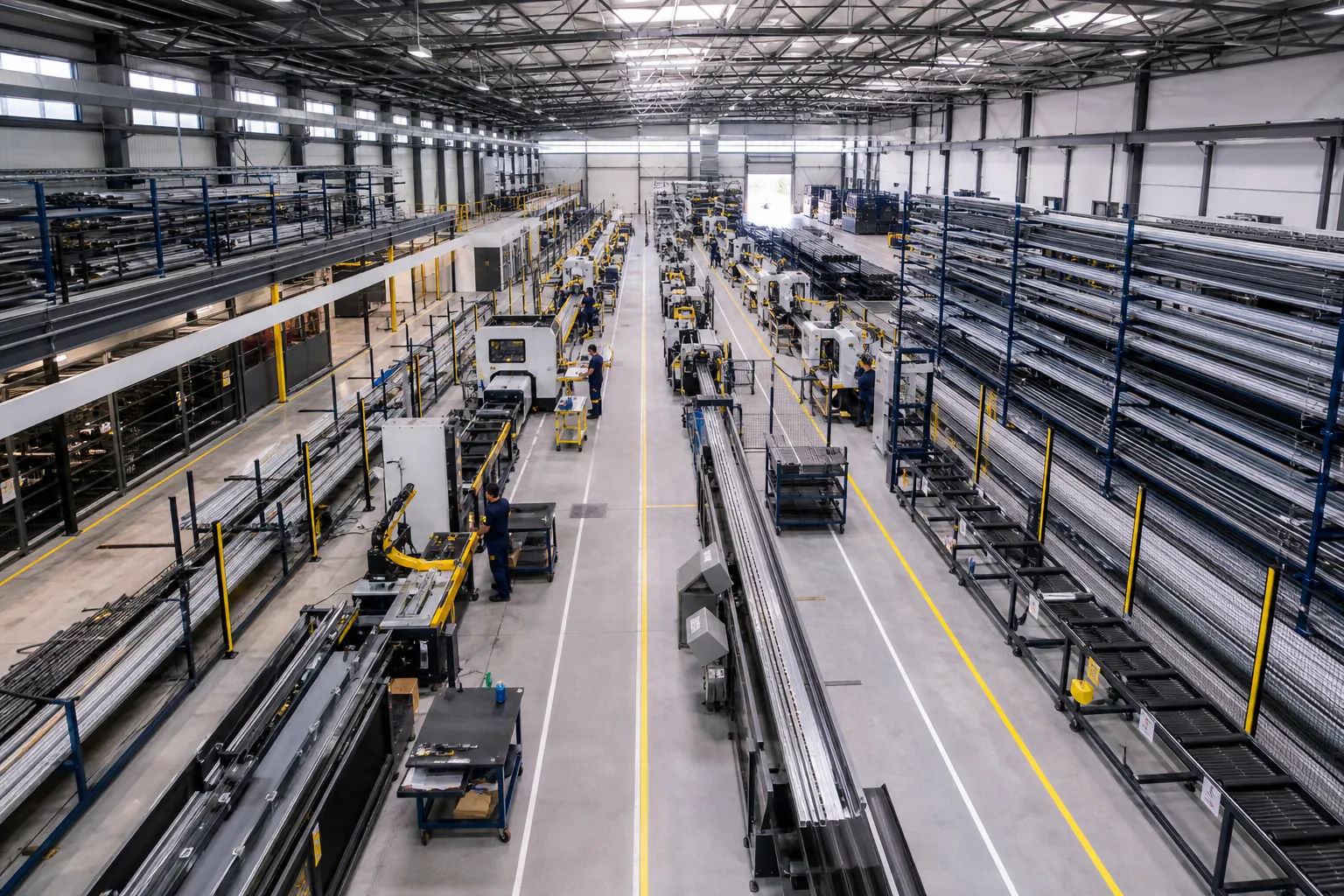
An autonomous, zero-waste fenestration factory
By the end of the roadmap, the engineering principles of the Zero-Waste Workshop are no longer aspirational. The 15% of margin traditionally lost to material scrap is recovered through multi-variable cutting optimisation, a tracked remnant inventory and a maintenance discipline that protects machine yield around the clock. Material handling stops being a vulnerability and becomes a strategic advantage.
Equally, the methodical execution of the 90-Day Roadmap means that the substantial capital invested in CNC machinery actually delivers the throughput it promised. With RA Workshop acting as the central digital nervous system — pushing exact, error-free instructions directly to machines and replacing paper routing with live, barcode-driven workflows — the facility crosses the line from traditional manufacturing into genuine Industry 4.0.
Insulation against external market shocks, uncompromising product quality, and a scalable, profitable foundation for growth: that is what this discipline buys. The work is not glamorous — it is checklists, layout decisions, database hygiene and tool offsets — but it is the work that decides which fenestration manufacturers thrive in 2026 and which ones get consolidated.
Ready to plan your own 90-day rollout?
Book a working session with our implementation team. We will walk through your current cutting yield, your machinery brands and your floor layout, and turn this article into a project plan you can run on Monday morning.
Continue reading
The Dealership Multiplier and ROI Calculator
A strategic framework for fenestration CEOs: multiply your dealer network through centralized architecture, then quantify the recoverable profit hidden inside quoting, errors, materials and throughput.
Read articleSales & growthStrategic Fenestration Sales 2026: mastering showroom conversion and B2B acquisition
A 27-minute playbook for fenestration teams: the 5-minute B2C quote formula and the technical B2B Architect & Builder Magnet — both powered by the RA Workshop ecosystem.
Read article