
Why digital transformation is now a survival prerequisite
The fenestration and door manufacturing industry is in the middle of a structural reset. Supply-chain volatility, persistent labour shortages and tightening regulation have already produced a measurable consolidation: in the United Kingdom, the count of operational PVCu fabricators contracted from 1,327 in 2019 to roughly 1,132 by early 2025, with bifold specialists shrinking even faster. Yet aggregate market demand keeps rising, driven by stricter energy codes, government-backed retrofit programmes and a slow but real recovery in new-build residential construction.
The result is a polarised market. Premium fabricators that have invested aggressively in automation and digital infrastructure are absorbing the share that smaller, manually-operated shops can no longer profitably defend. For owners and CEOs, the strategic challenge has shifted away from physical capacity expansion toward systemic efficiency. In a market where a new factory unit or another twenty skilled welders are either unaffordable or unavailable, scale has to come from digital architecture.
Two specific bottlenecks dominate. The external one is the management of decentralised dealer networks. The internal one is the data handover from sales estimation into factory production. Legacy methods in either domain impose a latency penalty that prevents the company from reacting to market signals and quietly erodes margin every day. This article is a two-part response: the Dealership Multiplier, which fixes the external problem with the right architecture, and the ROI Calculator, which quantifies the internal one in cash terms a board can act on.
Why legacy dealer management bleeds you on every transaction
Managing external dealers through email threads, phone calls and ad-hoc spreadsheets is a workflow that fails at every joint. A consumer walks into a showroom, the dealer assesses the requirement and forwards a rough sketch or a text-based email to the manufacturer. A salesperson or an engineer at the factory deciphers the request, makes clarification calls, and re-keys the parameters into the production system. Each handover is a chance for transposed digits, missing options and quietly wrong assumptions to enter the order.
The modern B2B buyer has stopped tolerating that friction. Procurement managers expect the same frictionless digital experience their consumer apps have trained them to demand. When the buyer hits inventory constraints at one distributor and a 48-hour communication delay at another, they go to the technologically advanced competitor — and the manufacturer, blinded by the lack of network visibility, never knows the buyer was ready to spend.
Speed of response is the second silent killer. The 'Quote Lag Time' metric — minutes from initial enquiry to delivered price — is now a primary competitive differentiator. Manual quoting routinely turns this into two to five business days. By day seven the manufacturer is in the 'Dead Zone': a digitally enabled competitor has already delivered a comprehensive, professional quote in fifteen minutes, anchored the buyer's price expectations, and framed the entire commercial conversation. The slower house is invisible before its spreadsheet is even opened.

The RA Server 3-tier architecture
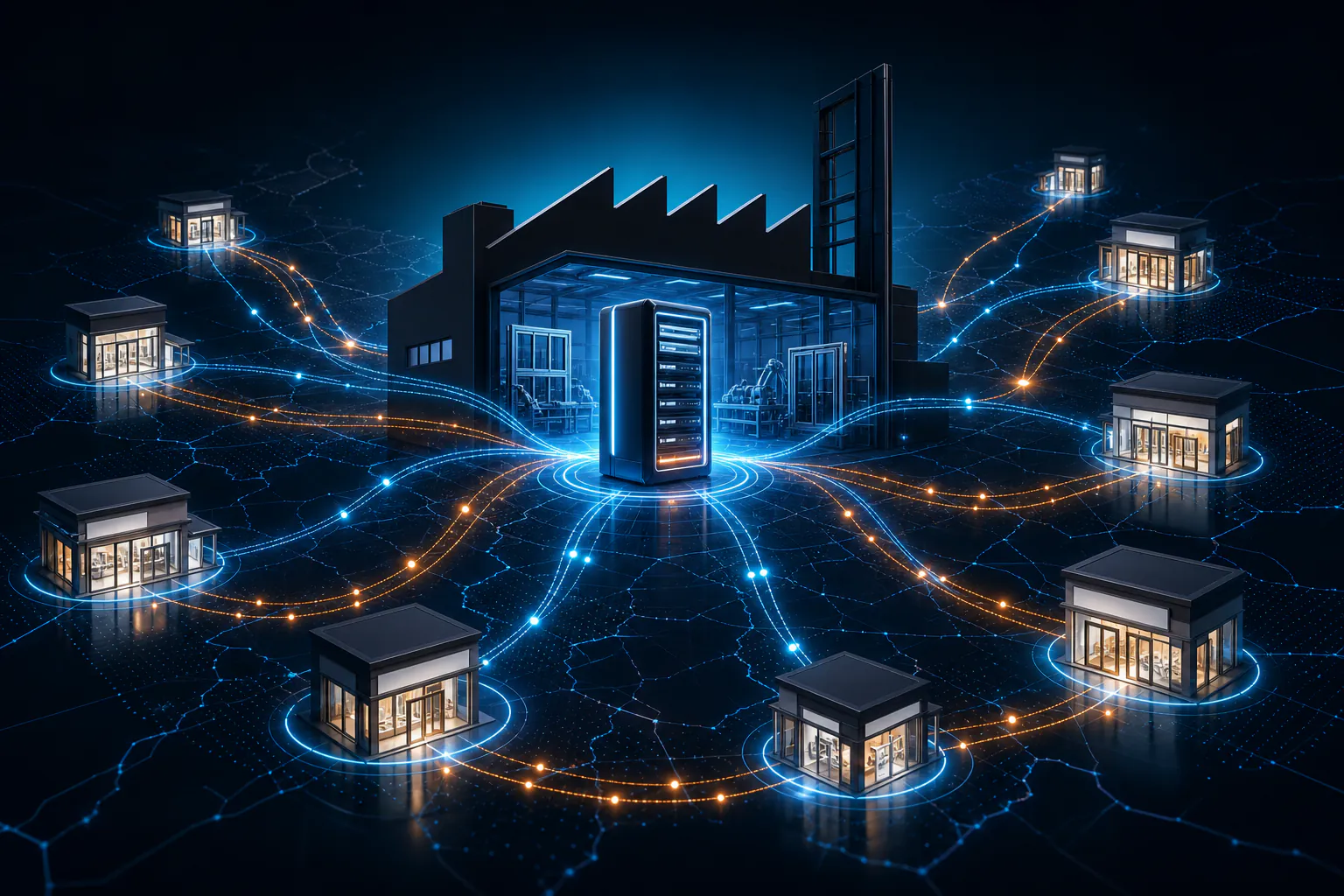
The way out of this friction is a single source of truth. The RA Workshop Client–Server edition is engineered for medium and large fenestration manufacturers exactly to centralise that source. Rather than running disconnected desktop installs that drift out of sync, the platform sits on a 3-tier architecture designed for performance, reliability and enterprise scale.
The first tier is the RA Workshop Database Server, running on Microsoft SQL Server. It is the impregnable central repository for the data the business is built on: live material costs, hardware specifications, glass lists and historical projects. Because everything is in one place, a profile or pricing change is instantly visible to every showroom and every estimator — there is no scenario where someone is quoting from last quarter's pricing sheet.
The second tier is the RA Workshop Server itself, deployed as a Windows service. It is the coordination engine: it manages active client connections, executes commercial logic and routes data securely between estimator workstations and the database. It is the computational brain.
The third tier is the RA Workshop Client — Lite, Express or Professional — paired with a Client Access License. The same live database is used by estimation, procurement, production and dispatch, simultaneously. A granular roles-and-permissions model lets a junior estimator generate quotes without being able to alter global pricing rules, while floor managers get full access to the production schematics and CNC files.
Empowering the network with the RA Dealer cloud platform
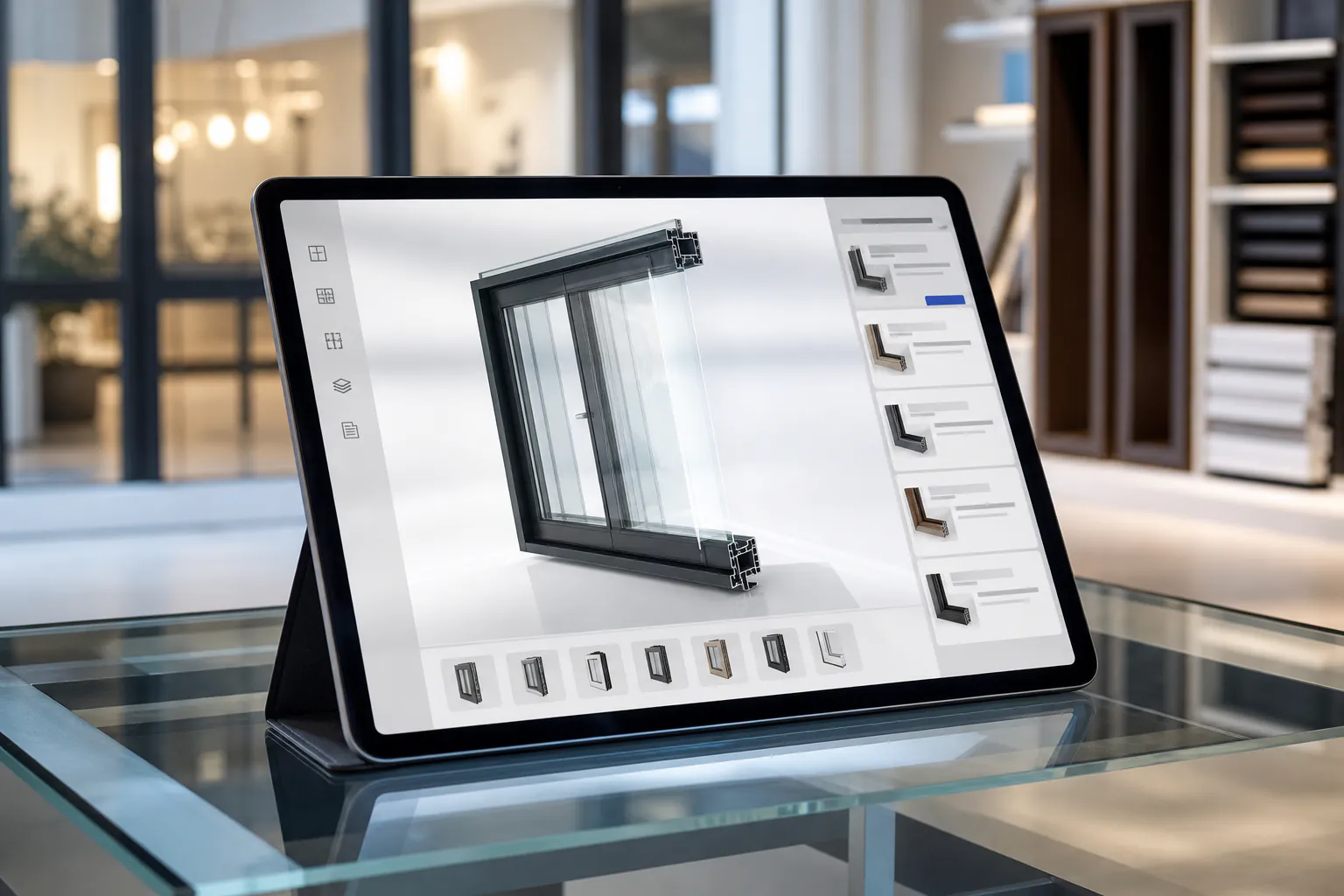
To genuinely multiply the dealer network, the digital infrastructure has to extend past the factory walls and onto the showroom floor itself. The RA Dealer module is a cloud-based estimation environment for dealers that completely shields the manufacturer's backend margins, costs and proprietary engineering rules.
The workflow transforms. The manufacturer (acting as the fabricator) defines the catalogue: standard products, custom architectural configurations, accessories, materials and base prices. The dealer hierarchy is then modelled — dealers can manage multiple showrooms with multiple sales reps, and the manufacturer assigns distinct price levels and discount matrices per dealer based on volume, geography or partnership tier.
At the point of sale, the experience is fully digital. The sales rep logs into RA Dealer from any internet-connected device and configures the window interactively with the customer. They can pick complex shapes (round, trapezoid, custom architectural), opening types (tilt-and-turn, parallel slide-and-tilt, bifold), and any of the supported materials (uPVC, aluminium, wood, steel). As the configuration is built, the integrated RA Workshop computation engine prices it in real time against the matrices the factory defined. Two outputs are generated simultaneously: a polished, branded customer quote, and a separate Dealer Quote that shows only the wholesale price the dealer owes — the manufacturer's true cost and net margin remain hidden.
Crucially, because the dealer is constructing the order using the manufacturer's own constraint database, the platform makes it physically and mathematically impossible to specify a configuration the factory cannot build. RA Dealer is a permanent, automated engineering check that prevents unbuildable designs from ever reaching production. When the consumer approves the quote, the order flows directly into the central RA Server as a validated, production-ready order — bypassing manual data entry entirely.
Workflow synchronisation across the digital thread
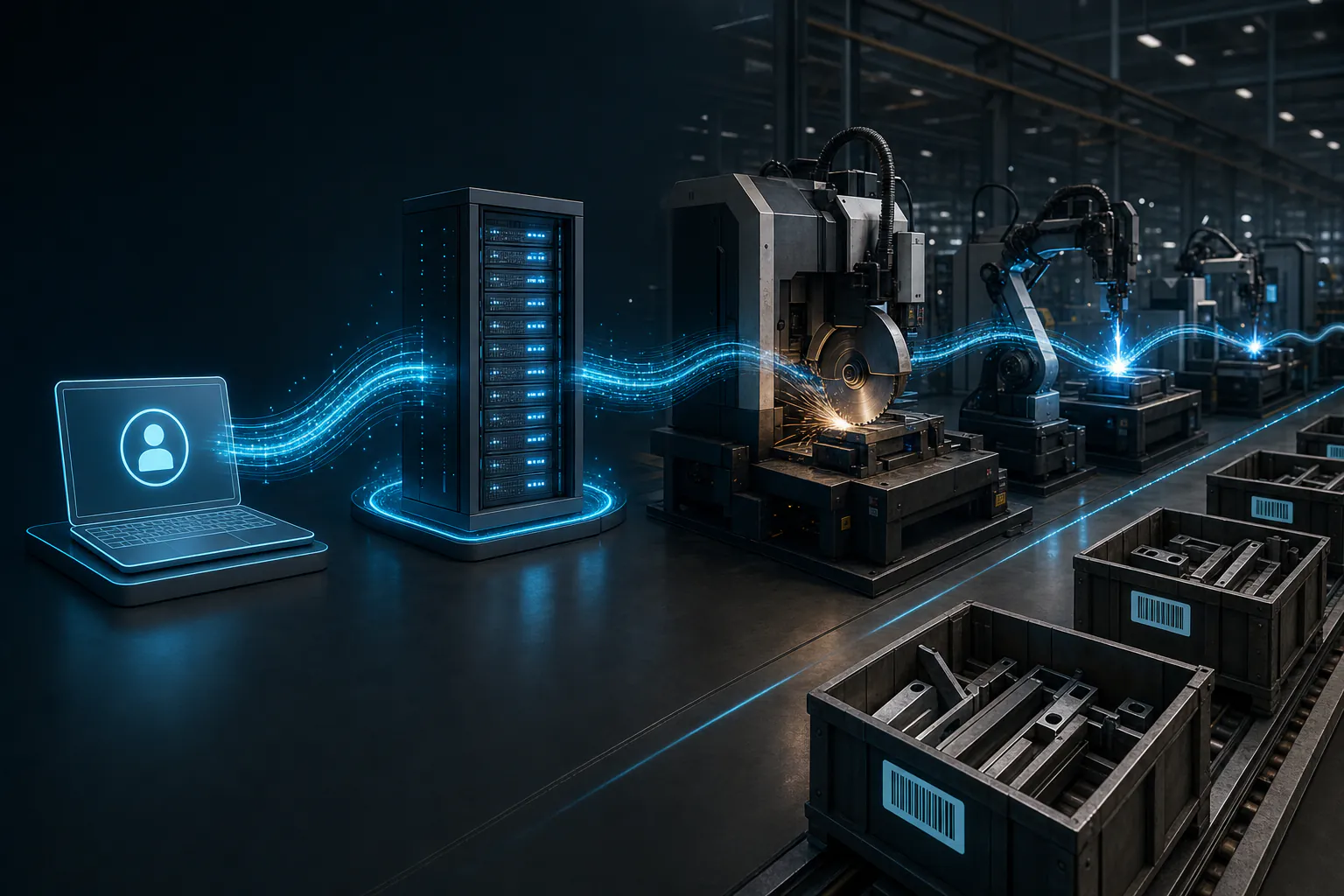
The leverage hidden in this architecture only fully unlocks when the digital thread reaches all the way from the showroom to the cutting saw. The strategic objective is an Industry 4.0 paperless factory where data flows without human interruption from the moment of sale to the moment of dispatch.
When a dealer submits an order via RA Dealer, the central RA Server processes the geometry of every window in the configuration and generates the precise machine code each piece of equipment expects. The data is sent directly to the integrated CNC equipment on the floor — Elumatec, Graf Synergy and Kaban cutting centres; Soenen Hendrix and Sturtz welding lines; complex multi-axis machining centres. Operators are completely bypassed for input. The exact mathematical dimensions the customer signed for are the exact dimensions the saw executes.
Smart Office Tools layer continuous internal logistics on top. As cut profiles leave the saw, integrated industrial printers apply durable barcode or QR labels. Through assembly, welding and quality control, handheld scanners or BLE gateways record the completion of every milestone. The centralised system updates instantly, giving floor managers and production directors live, granular visibility of every work-in-progress item. Bottlenecks are surfaced the moment they form, lines can be rebalanced dynamically, and the dealer network gets precise delivery forecasts back — which fundamentally upgrades the customer service the manufacturer can offer.
Finding the hidden profit in your current workflow
For CEOs and finance directors, an enterprise software deployment is not an IT line item — it is a capital investment that has to be justified with a rigorous ROI calculation. ROI is the universal financial metric that measures the net gross profit generated relative to implementation cost, and a well-built business case will quantify the hidden administrative drag, the manual drafting inefficiencies, the catastrophic order error rates and the material wastage already buried in legacy operations.
The numbers tend to be larger than executives expect. The transition from highly manual to fully automated workflows routinely yields a threefold ROI in the first year, alongside documented 77% reductions in workflow cycle time and 87% increases in invoice-processing velocity. The four modules below let you plug your own operating data into proven industry frameworks. By the end you will see exactly how much capital is bleeding out of operations every day, and how a platform like RA Workshop reverses the flow.

The administrative black hole of quoting and drafting
The financial impact of manual quoting is insidious because it drains direct labour and inflicts large indirect opportunity costs at the same time. Generating an accurate quote for a complex commercial fenestration project requires a senior estimator or draftsman to pull product data, verify pricing across disconnected vendor catalogues, calculate labour, and format a professional document. Time studies in custom manufacturing put this at roughly an hour of skilled engineering time per part, plus another half hour to produce manufacturing-ready drawings. In woodworking and fenestration specifically, working drawings can consume 6–10% of total project cost. Across a project of dozens of customised windows, a single quote can absorb days of administrative labour.
An automated engine like RA Workshop Express compresses the same configuration into under five minutes. The backend modules instantly compute every element of the window into an exact bill of materials, bypassing the human drafting bottleneck completely. To quantify the recoverable profit, evaluate your specific volume and labour rates against the automated benchmark.
| Cost vector | Manual workflow | Automated workflow | Recoverable profit |
|---|---|---|---|
| Annual quoting volume | Total quotes generated per year | Total quotes generated per year | — |
| Average time per quote | Industry average 2–4 hours | Benchmark 0.1 hours | Differential in hours |
| Total annual quoting hours | Volume × manual time | Volume × automated time | Total hours saved |
| Average hourly labour cost | Fully loaded estimator cost (e.g. $70/hr) | Same fully loaded cost | — |
| Total annual labour cost | Manual hours × hourly cost | Automated hours × hourly cost | Net annual savings |

The catastrophic cost of order errors and exception processing
When a dealer network runs on emails and phone calls, manual transcription into the manufacturer's system carries an industry-average 3% error rate. Exception processing alone — identifying and correcting the digital record — costs roughly $30 per error. For a high-volume manufacturer that is already six figures a year before any physical scrap is generated.
The administrative cost is the surface impact. The downstream cost of an error that survives engineering checks and reaches production is much larger. An incorrect dimension, a wrong profile colour or an incompatible hardware set produces a window that has to be scrapped. The true loss includes the wasted PVC, aluminium and IGUs, but also the disruption of the optimised production schedule, the delay imposed on every other order in the queue, the expedited freight that follows, and the reputational damage with the dealer and the consumer. Industry-average remake cost ranges from $200–$400 for a standard residential pane and exceeds $1,000 for arched or bay windows.
RA Workshop's constraint engine and the RA Dealer portal eliminate the entry point. The bill of materials is generated from the user's own design parameters; transposed digits, misread handwriting and outdated pricing sheets are mathematically eradicated.
| Cost vector | Manual workflow | Automated workflow | Recoverable profit |
|---|---|---|---|
| Annual units produced | Total units manufactured per year | Total units manufactured per year | — |
| Error / remake rate | Industry baseline ~3% | Benchmark < 0.1% | Reduction in error rate |
| Annual remake units | Total units × error rate | Total units × automated rate | Remakes prevented |
| True cost per remake | Materials + labour + schedule disruption | Same true cost | — |
| Total annual cost of errors | Remake units × true cost | Automated remake units × true cost | Net annual savings |
Material wastage and inventory capital optimisation
Inventory costing and material management determine three things at once: profitability reporting, tax compliance and operating cash flow. Fenestration is run on expensive raw materials — architectural aluminium extrusions, multi-chamber uPVC profiles, specialised glass — and poor inventory management swings between twin failures: bloated carrying cost from overstock, or production-line shutdowns from stockouts.
An automated platform produces real-time visibility of stock levels and consumption rates against incoming orders. By analysing historical quote and project data — including opening types, preferred profile systems and colour trends — manufacturers can forecast aggregate demand with high precision, optimise inventory turnover, and free working capital that is otherwise tied up on the rack.
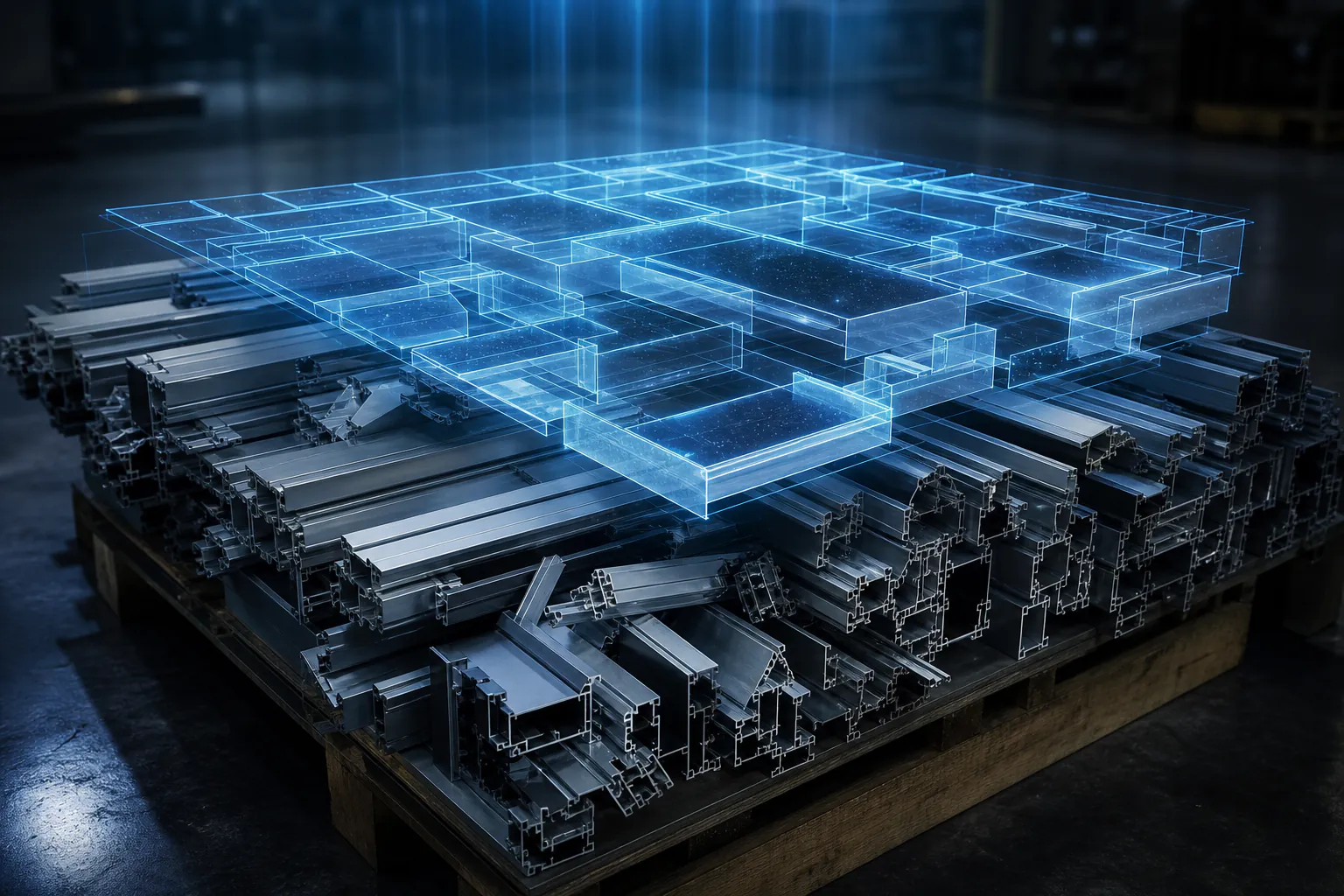
The bigger lever is algorithmic cutting optimisation. RA Workshop Professional's optimiser analyses the daily production run and computes the most efficient nesting sequence across raw profiles. Implementations consistently show profile wastage falling below 5%, a direct material saving of 12–20% versus manual cutting calculations.
| Cost vector | Manual workflow | Automated workflow | Recoverable profit |
|---|---|---|---|
| Annual raw material spend | Total annual cost of profiles and extrusions | Total annual cost of profiles and extrusions | — |
| Wastage percentage | Industry average 10–15% | Algorithmic benchmark < 5% | Reduction in wastage % |
| Total annual cost of waste | Material spend × current waste % | Material spend × algorithmic waste % | Net annual savings |
Operational agility and throughput maximisation
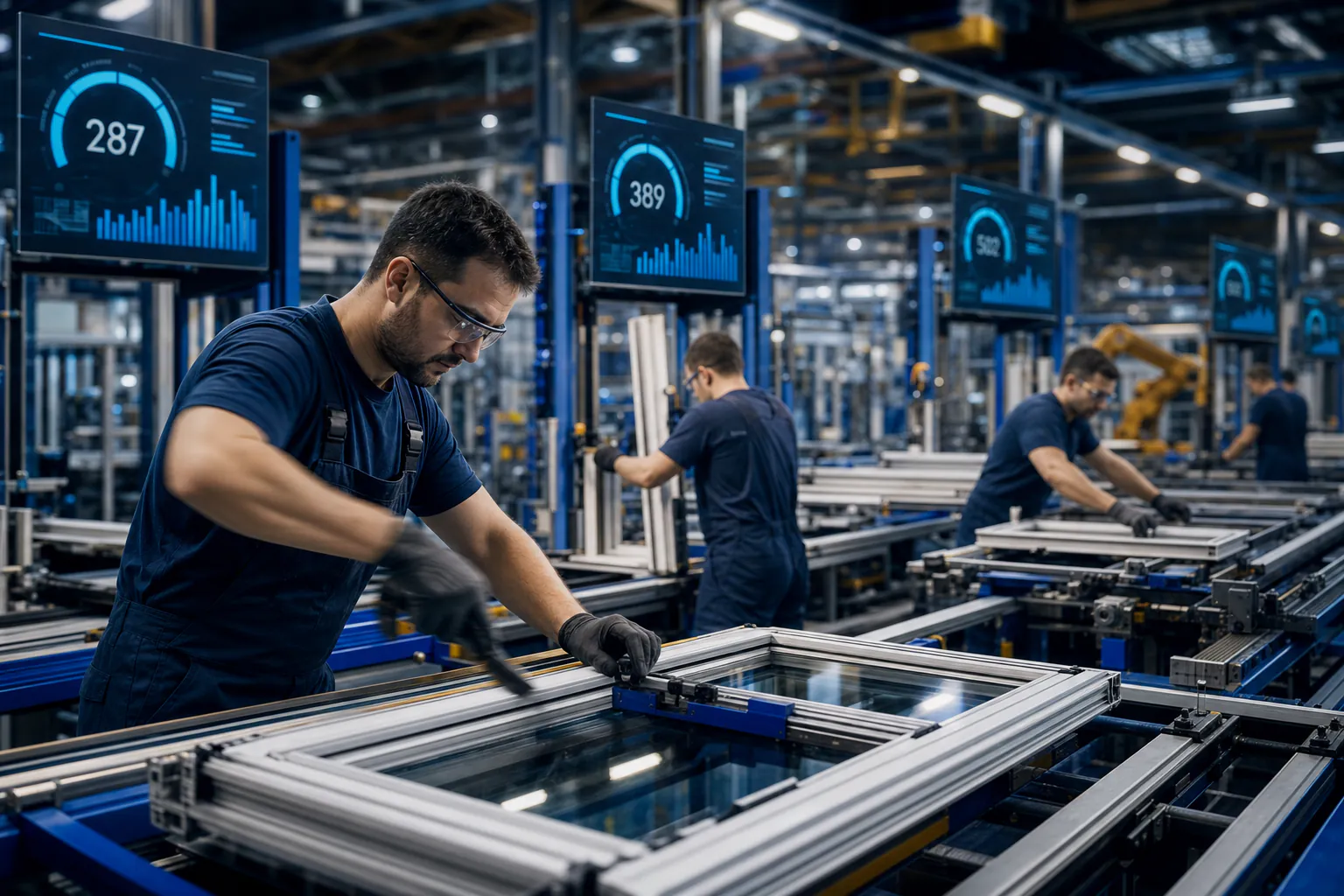
Beyond direct savings from error reduction and material optimisation, digital transformation unlocks throughput improvements that do not require proportional increases in variable cost or floor space. The cost of operational inefficiency is staggering: unplanned downtime and chaotic scheduling cost industrial manufacturers around $50 billion a year, and downtime in heavy industry approaches $300,000 per hour.
Empirical evidence from the fenestration sector confirms the upside. Dovista Polska's Window Village, an eight-factory complex serving the European market, was running at 60% of engineered standard productivity. Systemic workflow optimisation lifted raw productivity 30% in three months, sharply improving its ability to meet surging demand. Ultimate Windows in Australia used RA Workshop to bypass administrative bottlenecks: by sending engineered files directly from the quote to the machinery, the firm saved on operational staffing and substantially increased output.
When the system automatically generates glass orders, purchase orders and cutting lists in parallel, engineering staff are freed from administrative drudgery. That capacity gets redeployed into bespoke product development, deeper quality control and continuous process improvement — the work that compounds over years.

The master ROI: turning the four modules into one number
The ultimate purpose of the calculator is to consolidate the disparate cost vectors into one undeniable financial mandate. Combining the outputs of the four modules produces Total Net Operational Savings — the figure that rebuilds the conversation around the platform from 'IT expense' into 'profit multiplier'.
Once total savings are established, the ROI on the software, hardware upgrades and onsite implementation follows the standard formula: net annual benefit divided by total implementation cost, expressed as a percentage. It is common for comprehensive automation deployments in manufacturing to deliver returns of 300–400% within twelve months. When the math says the investment will pay itself back several times over inside a single year, the software stops being an operational expense and becomes the most powerful profit multiplier available to the enterprise.

Phased implementation and change management
The theoretical ROI of any platform is irrelevant if the implementation cannot integrate with the realities of the factory floor. CEOs frequently delay modernisation purely out of fear of the operational downtime a transition can introduce. That fear is rational: unplanned downtime triggers cascading schedule disruption, emergency overtime and expedited shipping. The antidote is a structured, risk-mitigated deployment partitioned into three controlled phases.
Phase 1 is Pre-Implementation, conducted off-site with the vendor. The implementation team performs a forensic analysis of the manufacturer's existing estimation methods, pricing structures and workflows. The foundational database is built from the documentation provided — every profile system (Aluplast, Schüco, Reynaers and others) and the matrix of proprietary hardware components. Crucially, the vendor collaborates directly with the manufacturer's CNC machinery suppliers in this phase to develop, test and calibrate the file export formats that will eventually drive the cutting and welding lines.
Phase 2 is Onsite Implementation. Specialised teams arrive at the facility with deep expertise in costing, database definition and CNC machining. They map the software logic onto the physical layout, define the multi-user access roles across departments, and run exhaustive 'BOM Checking': complex legacy projects are pushed through the new system to mathematically prove the automated calculations match physical manufacturing. Cutting calculations are tested live on the floor, with the optimiser's results compared against historical manual planning to demonstrate the savings.
Phase 3 is Go-Live and Fine-Tuning. The system enters daily production. Trained users monitor live data flow as orders arrive from RA Dealer, traverse RA Server for commercial processing, and reach the floor as CNC code and barcode labels. Optimisation parameters and machine linkages are continuously tuned against real-world feedback to push speed and yield.
The technical deployment is half the project. The other half is overcoming institutional inertia. Personnel accustomed to manual processes and paper routing may view automated scheduling and algorithmic optimisation with scepticism, or as a threat to job security. Leadership has to communicate, transparently and repeatedly, that the purpose of the platform is to remove repetitive, low-value administrative strain — not to replace people. Hands-on onsite training is essential, both so staff understand how the new interfaces work, and so they internalise how the resulting data flows accelerate their own workflow and reduce their everyday frustration.

Strategic synthesis: a profitable, scalable, defensible operation
The fenestration industry has reached a point where digital competency is no longer a competitive advantage — it is a prerequisite for survival. As consolidation accelerates and B2B buyer expectations shift toward instantaneous digital transactions, no manufacturer can afford to operate on disjointed, manual workflows.
For CEOs focused on scaling and protecting margin against macroeconomic headwinds, the strategic path is a holistic upgrade. A cloud-based dealer network through RA Dealer turns dealers from passive, frustrating communication channels into active, technologically constrained extensions of the factory itself — expanding sales capacity geographically without proportional administrative headcount. A 3-tier architecture through RA Server centralises data integrity so every part of the business — quoting, procurement, CNC, dispatch — runs from a mathematically flawless single bill of materials. And advanced cutting optimisation drives the largest cost centre, raw material, into a permanently lower base.
The decision is mathematical. The capital cost of acquiring, customising and implementing the software is rapidly and permanently eclipsed by the structural reduction in operating expense, the maximisation of throughput, and the enlarged share of an expanding market that the resulting speed makes available. By converting the quoting and production workflow from a slow, manual liability into a rapid, automated digital asset, fenestration manufacturers build genuinely scalable partner networks that can dominate the modern construction market.
Want us to run the ROI numbers on your shop?
Send us your annual quote volume, your remake rate and your raw material spend. We will return a custom ROI projection for the four modules in this article — no slide deck, just a working spreadsheet and a follow-up call.
Continue reading
The Zero-Waste Fenestration Facility: a 2026 master guide to profile optimization and CNC automation
A practical blueprint for production managers and factory owners: cut material scrap from 18% to under 5%, then walk through a disciplined 90-day roadmap to a fully CNC-integrated, paperless shop floor.
Read articleSales & growthStrategic Fenestration Sales 2026: mastering showroom conversion and B2B acquisition
A 27-minute playbook for fenestration teams: the 5-minute B2C quote formula and the technical B2B Architect & Builder Magnet — both powered by the RA Workshop ecosystem.
Read article